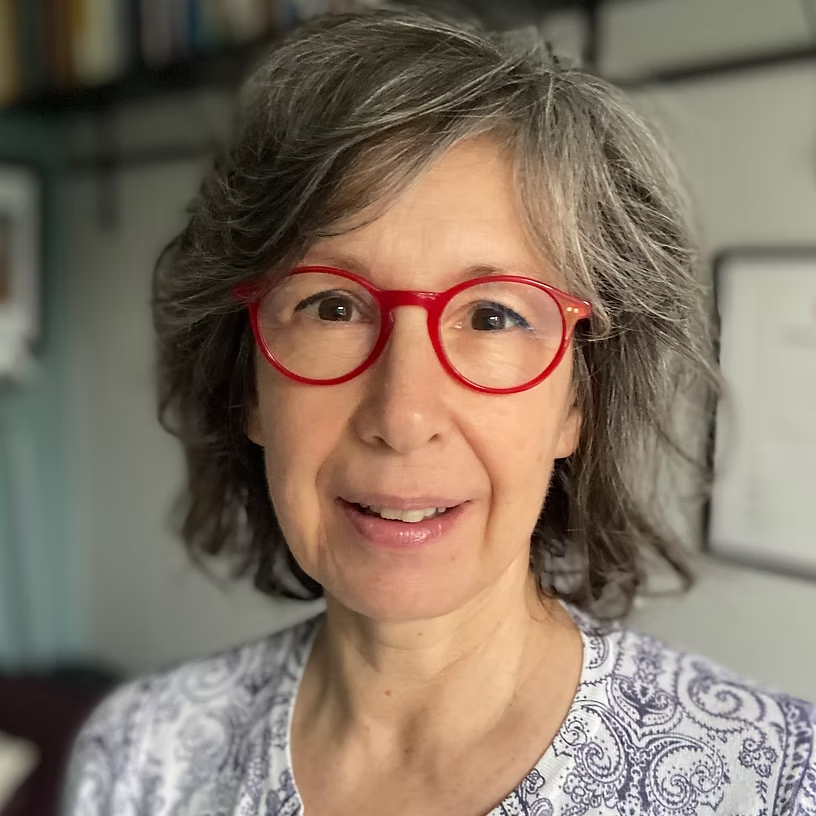
Sophie Harrison is a counsellor in London and online
What attracted you to become a therapist?
My interest in supporting others has been a thread throughout my professional life. Over the years, this has included programmes helping people return to work, literacy tutoring and training, community food and cooking projects, workshop design and delivery, business ownership with a focus on employing other mums, organisational development and HR, and training and development.
When my life changed profoundly in 2015, I decided to deepen these skills and retrain as a counsellor. In many ways, becoming a therapist felt like a natural evolution of something that had always been present in me: an innate pull towards supporting others as they navigate change, difficulty, and growth.
Where did you train as a therapist?
I trained at The Psychosynthesis Trust in London.
Can you tell us about the type of therapy you practise?
Psychosynthesis first attracted me when I experienced it as a client. What struck me was the sense that I could bring anything and everything into the therapeutic space — the known and the unknown, the difficult and the hopeful. I felt held in all of it: the “s*** and sugar” of being human. As I explored how I might offer this kind of space to others, I discovered that psychosynthesis has a wide range of ideas and approaches. But what spoke to me most was its underlying intention. It asks questions such as: Where is your choice? What gets in the way of living from that choice? What is trying to emerge in your life? These aspects of psychosynthesis continue to draw me to the work and to how I am paying it forward: how I am supporting clients in exploring their lives more deeply, becoming clearer about themselves, and moving closer to the centre of their own lives.
How does Psychosynthesis help with symptoms such as anxiety, depression, confusion, pain, or disappointment?
My practice offers a space to speak about and acknowledge what may not have been allowed, expressed, or fully understood before. Through this process, it can become clearer what is present in your life — what may need to be managed, coped with, understood differently, or chosen differently.
Together, we build a fuller picture of what really makes you tick: your experiences, patterns, responses, hopes, and difficulties. Symptoms such as anxiety, depression, confusion, pain, or disappointment can then be explored not as isolated problems, but as part of the wider story of your life. From there, change can become more possible.
What sort of people do you usually see?
I work with adults aged 18 and over. My clients come with many different backgrounds, experiences, and identities, but there are often some common threads: confusion, feeling trapped, loss, pain, anger, pressure from other people’s expectations, uncertainty about who they are, repeating patterns, difficulty changing, and/or a longing for change.
These experiences are deeply human, but they are also unique to each person. Therapy with me offers a space to explore those experiences with care, supporting greater clarity, understanding, and more choiceful action.
Have you noticed any recent mental health trends or wider changes in attitude?
I have noticed greater self-awareness among clients. Many people now arrive with more language and understanding around mental health, relationships, patterns, and trauma than they might have had in the past.
At the same time, clients often describe getting stuck at the point of: “How can this knowing actually change my life?” There is so much information available now, and while it can offer understanding, it can also create confusion. Therapy can help people move from insight into lived change.
What do you like about being a therapist?
Exploring barriers, beliefs and meanings formed in a client’s life, and seeing how therapeutic work can move towards greater clarity and choice. Each person brings a unique inner world, and getting to know them — sitting alongside them in that process — is a deep privilege. That is one of the reasons I love this work.
What is less pleasant?
What I find less pleasant is when mental health is ignored, dismissed, relegated, or devalued. The importance of emotional and psychological well-being is still too often underestimated.
How long have you been with Welldoing, and what do you think of us?
I have been a member of Welldoing since February 2026. I look forward to attending more live CPD sessions, although so far many have conflicted with my practice hours.
I enjoy the replays available on YouTube and other online portals, and I appreciate having access to ongoing professional development and support through the platform.
What books have been important to you in terms of your professional and personal development? Do you ever recommend books to clients?
Alongside books, audiobooks and online lectures have become an important part of my professional and personal development. I enjoy being read to, and I also value visual teaching.
When a client’s interests or difficulties resonate with a particular book, lecture, or workshop, I may suggest it as an additional resource. For example, I often find Tara Brach’s workshops on YouTube valuable for inner focus, self-acceptance, and self-compassion. There is a wide range of topics available, allowing clients to choose what speaks to them.
Most recently, I have enjoyed the book The Score by C. Thi Nguyen.
What do you do for your own mental health?
I remind myself of what I love.
I love walking and swimming outdoors, feeling the elements and being in nature. It grounds me and reminds me that I belong to the natural world.
I love music — listening to it and sometimes dancing in my kitchen.
Since COVID, I have also returned to sewing and have been learning more specific tailoring techniques. I love the process of making something two-dimensional become a three-dimensional shape, especially when it begins as what seems like far too many pieces. Perhaps I will be an engineer in my next life!
Where is your practice, and what can you share about seeing clients in this area?
My practice is in Tooley Street, London Bridge, and I also offer online sessions via Zoom.
Being based in such a dense and well-connected part of London brings real variety to my practice. The public transport serving the area seems to attract clients from further afield, including both commuters and local residents. I enjoy the diversity this brings to my client base and to the work itself.
What’s your consultation room like?
My in-person therapy room is a quiet, library-like room with dimmable lighting, standard lamps, and cushioned chairs. I aim to create a calm, comfortable space where clients can feel able to settle in and speak freely.
What do you wish people knew about therapy?
That it can help.
What did you learn about yourself in therapy?
I learned that I can be helped. I am OK. I can choose.