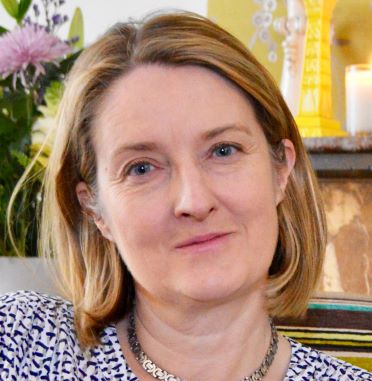
Joanne Petschek is a psychotherapist in London and online
What attracted you to become a therapist?
I started training in 2007 when my children were young. My mother had recently died, and I needed to find a new way to be. The training gave me something of my own to focus on while raising my family and looking after my busy household. I originally signed up for a one-year course for a Certificate in Counselling and Psychotherapy. I loved the course; I had learned a lot about myself and others, and I wanted to learn more. On completion, I decided to enrol for the four-year Diploma.
Where did you train as a therapist?
I trained for five years at the Centre for Counselling and Psychotherapy Education (CCPE). The school is the largest training centre for transpersonal psychotherapy in the UK. I loved going to my therapy school; it was situated in a beautiful building in Little Venice, London, next to Regent’s Canal. I enjoyed sitting by the canal watching the ducks and barges while I contemplated life.
A few years after finishing my psychotherapy training, I gained an Accredited Diploma in Transformational Coaching at Animas. The training took place at Regents College in the park. I love nature, and both training schools were partly chosen for their proximity to green space and water. That’s not such an easy thing to find in London!
Can you tell us about the type of therapy you practise?
I practise both psychotherapy and therapeutic coaching. In my psychotherapy practice, I offer an integrative approach with a person–centred slant. Transpersonal psychotherapy integrates modern Western psychological practices with a spiritual perspective. When appropriate, I encourage clients to dig deeper and integrate their body with their mind.
In my therapeutic coaching practice, I encourage clients to look forward and decide on action as well as contemplate the past. This is helpful for clients going through divorce and major life changes.
How does your type of therapy help with relationship issues?
I specialise in supporting individuals and families through the complex emotional and practical challenges of relationship struggles, divorce, separation, co-parenting and stepfamily dynamics. Therapeutic coaching is ideal for this area of work. When divorce and separation occur, there is often a lot of pain and disappointment to process, as well as action required to ensure practical and emotional needs are met.
What sort of people do you usually see?
I work with adults in individual therapy and therapeutic coaching. My clients normally range from their mid-twenties to older age groups. I volunteer as an Emotional Support Coach and Psychotherapist for a charity called Dads House, so I do support a high proportion of men for the charity.
Have you noticed any recent mental health trends or wider changes in attitude?
I have noticed that therapeutic coaching seems to be growing in popularity. When I first started training as a therapist, it played a much smaller role in the field. Therapists now seem to offer several modalities.
I spend quite a bit of time with young people. It pleases me to see that they are willing to talk about their feelings. I welcome this change.
What do you like about being a therapist?
I like the independence of being able to choose when I work. I particularly enjoy being able to volunteer at the charity. It is an honour to witness someone’s journey, both happy and sad, and it should never be taken for granted.
What is less pleasant?
Sometimes the work can be draining. Some of the work I do means that I get to meet people at what they believe is the very worst moments of their lives. I have to be very careful not to bring that distress home to my family. We were taught at therapy school how to take care of ourselves to create a separation from work and family life.
How long have you been with Welldoing and what you think of us?
I am very new to Welldoing. I have just joined! I fully intend to take advantage of the CPD sessions and support groups.
What books have been important to you in terms of your professional and personal development? Do you ever recommend books to clients?
There are two books that I believe every young person should be given. One is a Dr Seuss book – Oh, the Places You’ll Go. Don’t be fooled into thinking that this is just a children’s book. The other book should be Viktor Frankl’s book – Man’s Search for Meaning.
Books that I feel have personal importance: anything by Irving Yalom – I have so many of his books. I also have a soft spot for the works of Dr Winnicott; I think I first read his Home is Where we Start from. I am currently re-reading On Becoming a Person by Carl Rogers. For pure pleasure, I like to read anything by Jane Austin.
If you could mix Yalom, Winnicott, Frankl, Rogers, Austen, and Seuss and make a therapist, that’s the therapist I would like to be!!
What you do for your own mental health?
I was born in the Lake District and really suffer if I spend too much time away from mountains, lakes and countryside. I try to get back into nature as often as possible, as I feel centred when I am away from the city.
I love to cook for my family. I am a mum and step-mum to five adult children. There are also new little grandchildren. When we get together, the room is very noisy and full of love and happiness. We are a modern family, and I definitely try to practice what I preach. Happy stepfamilies and blended families are not a coincidence; they take time and effort to make sure everyone feels included, loved and appreciated.
My work also involves volunteering in a Family Law Clinic; therefore, I experience different angles to relationship breakdown. I take time to relax with a bubble bath after a long day.
You are a therapist in London. What can you share with us about seeing clients in this area?
My chosen line of work means that I see clients who are experiencing divorce and the ending of relationships. I see people face to face and online. This means that they can be anywhere in the world. People have very busy lives and their time is precious. Taking the time to process the end of a relationship is important, mainly so you don’t repeat your patterns in your next relationship. Still, if children are involved, you want to make sure they are looked after both emotionally and practically during the separation and that often requires immediate action.
We have several parks and a great climate in London, and I do offer walk-and-talk therapy. It is great in the summer but not so inviting on a rainy day!
What’s your consultation room like?
I have new consultation rooms in Chiswick in West London. They are light and airy and offer a peaceful environment, so people feel safe and contained to share their story.
What do you wish people knew about therapy?
Therapy is a great investment for your future, and you don’t have to be in crisis to start seeing a therapist. Therapy also has an ending. Learning to end things healthily is just as important to the work as the work itself!
What did you learn about yourself in therapy?
I had therapy for six years whilst in training. The most important thing I learned was to be authentic. It is such an easy word to say yet so difficult to practice. How do you be true to yourself whilst ensuring that you are not intentionally hurting others along the way? This is still something I grapple with, and I think it will be my lifelong lesson.