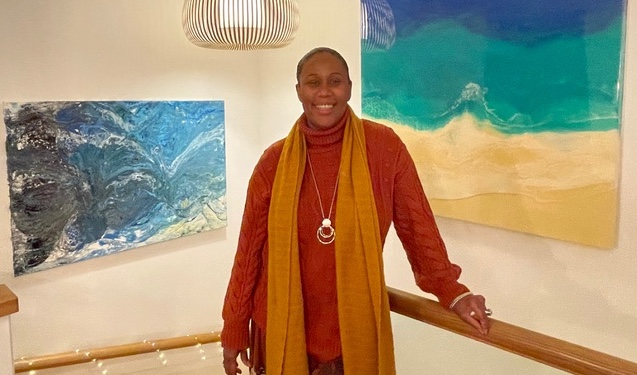
Sarah Colbourne is a therapist in Kilburn, London
What attracted you to become a therapist?
On June 14 2017, I lost friends, and my friends lost family members, in the Grenfell Tower fire. My community, friends, neighbours and my son, who lost a friend aged five at the time, were hurting. Friends who had lost their loved ones told me, ‘Time is precious and short; get the tools to help heal our community, Sarah.’
Where did you train?
I trained at The Minster Centre
Can you tell us about the type of therapy you practise?
I work from an integrative framework, with psychodynamic theory at the core of my practice. I pay close attention to unconscious processes, relational patterns, and the dynamics that emerge within the therapeutic relationship, seeing these as vital routes to understanding how a client has come to relate to themselves and others.
I view the therapeutic space as a collaborative environment where meaning can be co-created, and long-standing emotional and relational patterns can be gently explored and understood at depth.
My orientation is rooted in psychodynamic thinking, but I work flexibly, drawing on a range of other approaches, including person-centred, attachment-based, and trauma-informed modalities. This integration allows me to respond in a way that is both theoretically grounded and attuned to the evolving needs of each client.
I also reflect on cultural, social, and systemic contexts, especially when working with clients whose identities have been shaped by marginalisation or complex intergenerational dynamics.
My approach is relational, reflective, and process oriented. I aim to offer a consistent and containing presence where clients feel safe enough to bring their full emotional experience into the room — whether that involves vulnerability, resistance, shame, or uncertainty. I support clients in deepening their self-awareness, uncovering meaning behind emotional struggles, and identifying internal conflicts that may be operating outside of conscious awareness. My goal is to support clients in moving towards greater integration, emotional resilience, and a more compassionate understanding of themselves and their life experiences.
How does integrative therapy help with past trauma?
My integrative, psychodynamic approach offers a safe and collaborative space where clients can explore how past experiences shape present feelings and relationships. By paying attention to unconscious patterns and using the therapeutic relationship as a container, you help clients build trust, deepen self-awareness, and move towards greater emotional integration. Drawing flexibly on trauma-informed, attachment-based, and person-centred approaches, I meet clients where they are, supporting healing, resilience, and a more compassionate understanding of themselves.
What sort of people do you usually see?
Individuals, couples and group work
Have you noticed any recent trends in mental health or broader shifts in attitude?
Mental health awareness has grown, with more people seeking support, and the stigma around emotional health is slowly reducing, though demand is outpacing services. Rising anxiety, loneliness, and the impact of inequality highlight the need for accessible, culturally sensitive care.
What do you like about being a therapist?
I have the honour of accompanying someone on their journey.
What is less pleasant?
When I am approached and am unable to work with the client due to my schedule being full.
How long have you been with us, and what do you think of us?
I am a newbie, less than a month. I am excited to work within an organisation that is growing in stature and reputation, and the CPD sessions look amazing, along with the peer community.
What books have been important to you in terms of your professional and personal development? Do you ever recommend books to clients?
All the following books impacted me while on my training and are still a part of my core books to go to in need.
The Therapeutic Relationship by Petruska Clarkson
My Grandmother’s Hands by Reshma Menken
Thinking Spaces by Frank Lowe
What do you do for your own mental health?
I do Pilates, yoga and breath work classes. I also bake and enjoy street markets and festivals all year round.
You are a therapist in North West and West London. What can you share with us about seeing clients in this area?
In North West and West London, my client base often reflects the area’s cultural diversity and mix of socioeconomic backgrounds. I tend to work with people bringing issues around trauma, anxiety, relationships, and identity, often shaped by both personal histories and the pressures of city life.
What’s your consultation room like?
Natural, warm and spacious.
What do you wish people knew about therapy?
Therapy isn’t about being “fixed” — it’s a safe space to explore, heal, and grow.
What did you learn about yourself in therapy?
I learnt to live with the Good, Bad and the Ugly parts of myself.