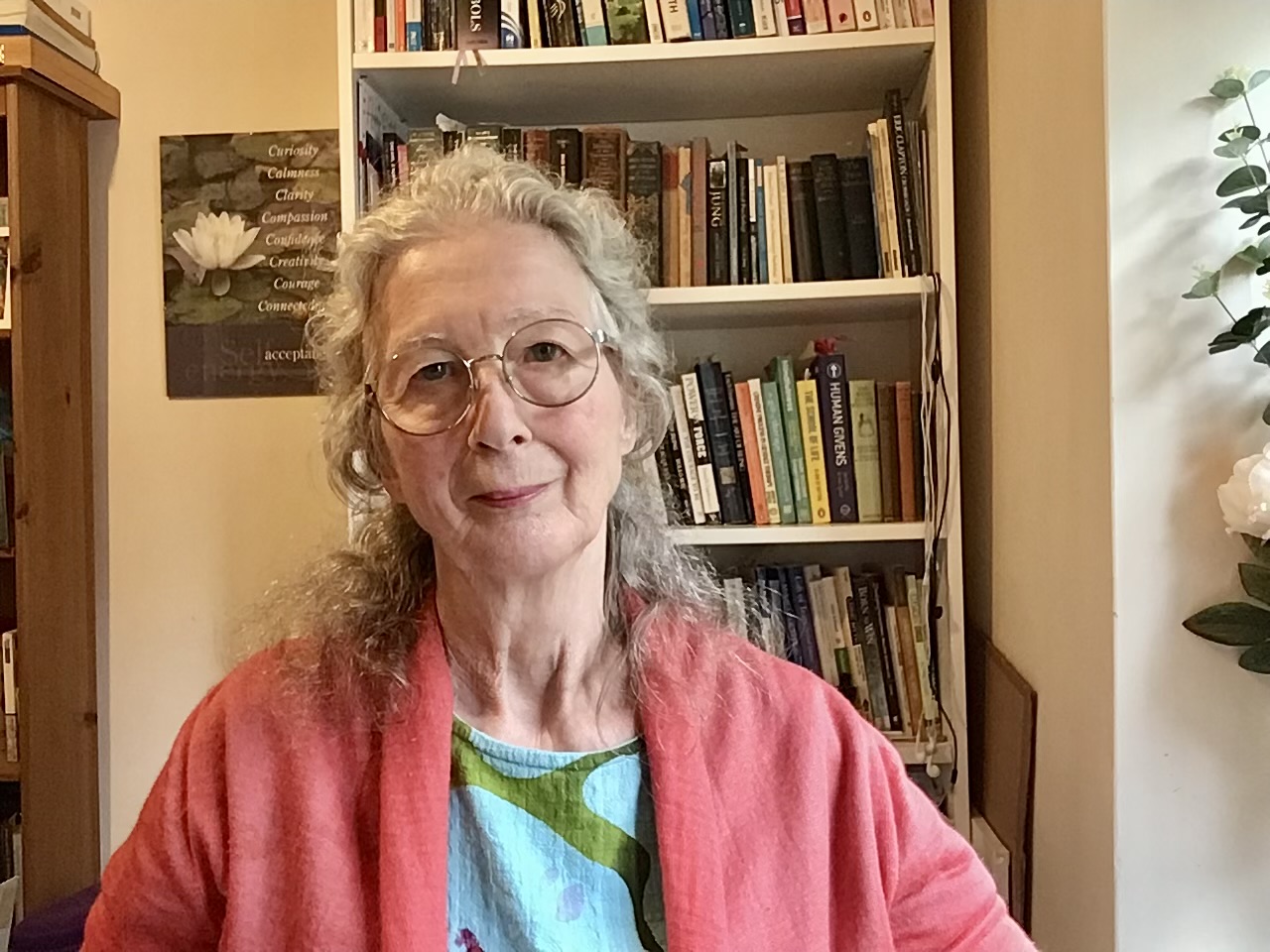
Jaquetta Trueman is a counsellor and psychotherapist online
What attracted you to become a therapist?
My path towards becoming a therapist developed gradually. I first came to therapy early in my career as a graphic designer, at a time when I was struggling in my first marriage. Both of us carried wounds from difficult childhoods, and we were trying to make sense of life, emotions and relationships without many of the tools we needed. Therapy opened the door to a long process of self-discovery. I read widely around self-help and personal growth and began asking questions I had not previously known how to put into words.
Some years later, with the encouragement of a wonderful Zurich-trained Jungian analyst whom I saw for three years, I began a one-year introductory course in analytical psychology (Jung) with the Guild of Analytical Psychology and Spirituality in 2004. As my self-awareness grew and I learnt the foundations of therapeutic work, I felt drawn to offer others the experience of being truly listened to, seen, heard and accepted. I think of Jung, along with Carl Rogers, as benevolent grandfather figures; I never knew either of my grandfathers, so in some ways I kind of adopted them. As I was not in a position to commit to the extensive training required for Jungian analysis, I explored other approaches and chose gestalt, person-centred and existential therapy training.
Where did you train as a therapist?
My training began at The London Gestalt Centre, where I completed a certificate course in counselling. I then progressed to a qualifying foundation degree in Humanistic Counselling with the University of Greenwich, in collaboration with Guildford College. I later completed a top-up bachelor of science degree in Reflective Therapeutic Practice at Metanoia Institute and Middlesex University.
Can you tell us about the type of therapy you practise?
My practice is grounded in person-centred, gestalt and existential therapy. I chose the person-centred approach because it offers a non-directive, collaborative foundation built on safety and unconditional positive regard. In our work together, gestalt and existential approaches can bring creative, experiential curiosity, helping you explore your present-moment experience and the meanings you make in life. Over time, I have also integrated other modalities where helpful, including Acceptance and Commitment Therapy (ACT), elements of Internal Family Systems (IFS), and polyvagal-informed breathwork for anxiety.
How does your type of therapy help with symptoms of anxiety and depression?
As with all therapeutic approaches, a strong therapeutic relationship is the foundation from which meaningful change can grow. My intention is to work with you in a non-directive, present-moment way, supporting you to develop a stronger sense of agency and emotional steadiness. By meeting you where you are, without judgement, we can gently explore the heaviness of depression or the spiralling loops of anxiety, helping you reconnect with your inner resources and move at a pace that feels manageable.
What sort of people do you usually see?
Most of the people I work with are adults of working age, currently ranging from around 19 to 60, with many in their mid-twenties to early fifties. You may be experiencing anxiety or depression, relationship challenges, low confidence or self-esteem, or a general sense of not feeling good enough. You may know that something needs to change, even if you are not yet sure how to begin.
Have you noticed any recent mental health trends or wider changes in attitude?
It seems to me that society is changing at an unprecedented pace, with fewer constants and several major shifts happening within a single generation. This instability is visible across many areas of modern life: widespread digitisation and the rapid rise of AI; economic shocks, de-industrialisation and the ongoing threat of job loss; the long-term impact of the COVID-19 pandemic on the NHS and on young people’s prospects; the move towards remote working, with its potential for social isolation; and the increasing strain of climate change. Together, these pressures can create a pervasive sense of unease, fuelled by division, fear and “othering”, and can widen the gap between different parts of society.
Alongside this, whether directly connected or not, I have noticed a clear increase in recent years in clients, more often women, who are either late-diagnosed or undiagnosed and are curious about neurodiversity, particularly ADHD.
What do you like about being a therapist?
It is a profound privilege to witness people building self-awareness, confidence, and a sense of agency over their thoughts and emotions as they integrate conflicting inner aspects of themselves. Because that growth belongs entirely to the client, I see my role as a collaborative facilitator—offering a calm, safe environment to explore and walk alongside them in their process.
What is less pleasant?
The most difficult moments are sudden endings, when someone stops therapy abruptly and without warning. It can leave me wondering what happened and whether there was anything I might have done differently. Thankfully, this has not happened often, but when it does, it stays with me.
How long have you been with Welldoing and what you think of us?
I am very new to Welldoing, and I am thoroughly impressed with the sense of community and opportunity to join peer support groups, benefit from the regular newsletters, CPD sessions and book of the month. The only CPD that has taken place since I joined was excellent. It was about the possibility of weaving in Homer’s Odyssey, particularly Odysseus’s prolonged journey home illustrating, as I understood it, how ego can get in the way of self-knowledge.
What books have been important to you in terms of your professional and personal development? Do you ever recommend books to clients?
A number of books have shaped both my personal development and my professional practice. Some have helped me make sense of my own experience, while others continue to inform the way I think about therapy, trauma, self-acceptance and the therapeutic relationship. I do sometimes recommend books to clients, depending on what feels relevant and supportive for them at the time.
For my own personal development:
- A New Earth. Eckhart Tolle
- Man’s Search for Meaning. Viktor E. Frankl
- The Presence Process: A Journey Into Present Moment Awareness
- *The Road Less Travelled. M Scott Peck
- *Radical Acceptance. Tara Brach
- *Healing the Child Within. Charles L. Whitfield, MD
- *Boarding School Syndrome: The Psychological Trauma of the ‘Privileged’ Child. Joy Schaverien
- *Mindfulness: a practical guide to finding peace in a frantic world. Mark Williams and Danny Penman
Books marked with an asterisk are titles I have recommended to clients in the past.
Professional Development:
- Awareness Dialogue & Process. Gary M. Yontef
- Creative Process in Gestalt Therapy. Joseph Zinker
- The Gift of Therapy. Irvin Yalom
- Existential Perspectives on Human Issues. Edited by Emmy Van Deurzen and Claire Arnold-Baker
- Developing Person-Centred Counselling. Dave Mearns
- Developing Gestalt Therapy. Jennifer Mackewn
- The Body Keeps the Score. Mind, Brain and Body in the Transformation of Trauma.
Bessel Van Der Kolk - A Practical Guide to Complex PTSD. Arielle Schwartz
- The Penny Model. Stefan Charidge
What do you do for your own mental health?
For my own mental health, I value daily mindful walks with my small dog, quiet time in a shaded part of the garden, and simply relaxing with my husband. This year I joined Woman Within Open Circles, which take place online twice a month; I try to attend at least one each month, where I know I can bring my authentic self and be accepted without judgement. For the past 18 months, I have also been seeing an IFS (Internal Family Systems) therapist, which has been invaluable to me.
You are a therapist in Torquay, Devon. What can you share with us about seeing clients in this area?
Although I am based in Torquay, Devon, I have worked mainly online since Covid, which has allowed me to see clients across the UK and, at times, in the EU and USA. When I was working with people primarily from Devon, I would not say there was anything that clearly defined them compared with clients from other demographic or geographic areas. That said, Torquay and the surrounding area rely heavily on tourism, which can contribute to financial insecurity for some people. I work with people from all walks of life, and life’s challenges arise wherever we are.
What’s your consultation room like?
My consultation room is small, private and cosy, although it is currently in a state of transition. If you would like to see me in person, I would be happy to welcome you here once the space is ready, or I can arrange to hire a therapy room nearby.
What do you wish people knew about therapy?
I wish more people knew that talk therapy does not need to be something to fear. Therapy is not about being told what to do, being judged or simply being given advice. It offers protected time for you: a space where you can be listened to, seen and heard with unconditional positive regard, and supported as together we work through whatever feels important to you.
What did you learn about yourself in therapy?
I have learnt that I can trust my senses and intuition more, that it is more than okay to be an introvert, and that self-awareness and self-acceptance are central to healthy emotional regulation and psychological flexibility.