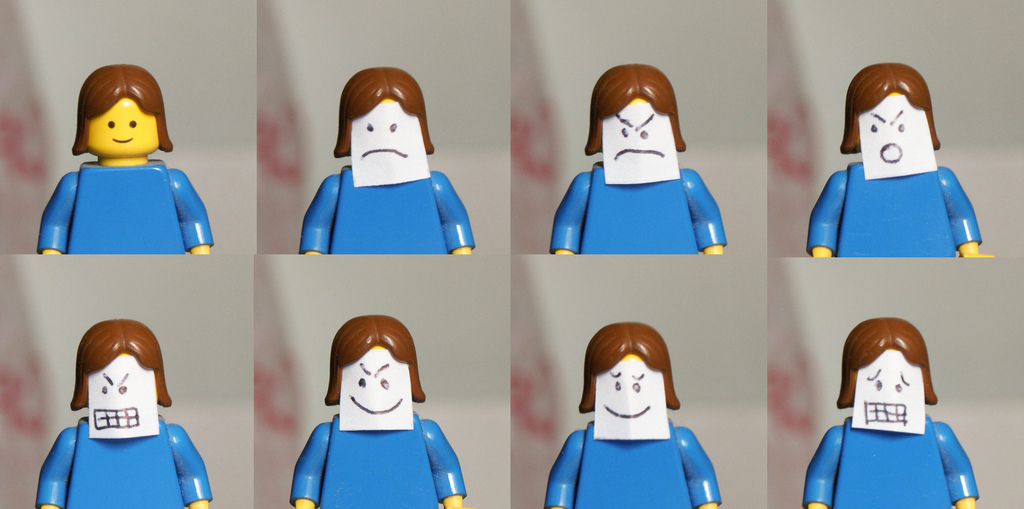
Think of a lens. Here, take it in your hand. I want you to hold this lens up to your eye and look at your life — all of it, past and present. Look at everything that’s ever happened to you, every experience, then look at the emotions you felt — anger or sadness or stress or insecurity or any of those other feelings we all have from time to time. Look at the pleasant emotions, too, like joy and contentment and satisfaction and love and pride and hope.
Now, focus on the things you said or did or thought in response to those emotions. Your kids misbehaved. Your boss asked questions about a project you managed. An old friend reminded you of something embarrassing you did long ago. You suddenly felt a weird pain in your chest.
In response to those things, what did you do? How did you react? Maybe you screamed at your kids. Or you spent the rest of the week fearing you’d be fired. Or you got mad at your friend but didn’t say a word. Or you spent a sleepless night scared you might be seriously ill.
When you experienced challenging moments, did you lose your cool or fly off the handle or freak out or melt down? Was your spirit crushed? Did you cower in fear? Were your hopes dashed? Did you give up on a dream?
Again, let’s not examine unhappy emotions only. Look through the lens at the first time you fell in love, or when you got a promotion at work and couldn’t wait to celebrate, or when you kicked your junk food habit and got healthy, or when someone praised you for being kind. How did you handle those feelings? Keep using your lens to examine every time an emotion influenced you to act one way or another, and now ask yourself: Did those actions help me, or did they hurt me? Did I deal with my feelings, especially the difficult ones, in ways that improved my life or made it worse? And how did my responses affect the people around me, the people I love? Was I my best possible self for them or some other version of me?
Taken all together, these moments determined the course of your life. You felt an emotion, and you reacted by saying or thinking or doing something in response. But what about the things that were beyond my control? you could fairly ask. It’s true, you can’t be responsible for what other people do and say.
But no matter how they behaved, you were the one who felt the emotion and reacted to it.
I’m going to say something that might strike you now as an exaggeration: Virtually everything that has ever happened in your life — good, bad, happy, sad, frustrating, satisfying, joyous, discouraging, depressing — was influenced by how you responded to your emotions. How you dealt with your feelings.
I’ll go even further: Pretty much everything that has gone right in your life was the result of you having an intelligent, helpful response to an emotion you experienced. And nearly every time something went wrong — meaning whenever an outcome was not the one you wished for and did not serve your goals — it was because you had an unwise reaction to what you felt. You did or said something you may even have regretted, something you wished you could take back and do over. Of course, there are times when illness or accidents affect us in ways beyond our control; even then, our responses to these situations make a difference. But there are no do-overs, only the future where we can do better. The degree to which you will get what you want out of life is equal to how well (or poorly) you deal with your feelings. That alone will make the difference between happiness and sadness, fulfilment and frustration, contentment and disappointment, success and failure.
You might possess extraordinary talents and valuable skills, but learning to regulate your emotions is essential to fully unlocking your potential. On the other hand, if you possess modest abilities but can deal wisely with your feelings, you will likely succeed in most aspects of your life.
Alas, many of us believe that the way we respond to our emotions is an intrinsic part of ourselves, a fixed aspect of our personalities — something at our very core, impossible to change. Which is simply not true.
It’s in our power to understand our emotions and decide how we’ll respond to them, and there are mindsets, skills, and strategies for doing that which can be taught and must be learned. By learning them, then using them, we’ll gain control over our lives and increase our chances of success — at home, at school, at work, and everywhere else.
This does not mean we’ll try to control our emotions. Or that we’ll suddenly be happy all the time. That’s impossible. We feel what we feel. But we can choose how we’ll respond to those feelings — what we’ll say and do and think. How we’ll deal. And those choices will make all the difference in our lives.
Think of the people we admire — the ones who face enormous challenges and don’t give in to the emotional upheaval they experience. We use the expression “grace under pressure” to describe it. The pressure is all the intense, triggering emotions we’ll ever face. The grace is the ability to stop ourselves from reacting in ways we later regret, and instead to deal with our feelings as we know we should — in ways that reflect our best selves.