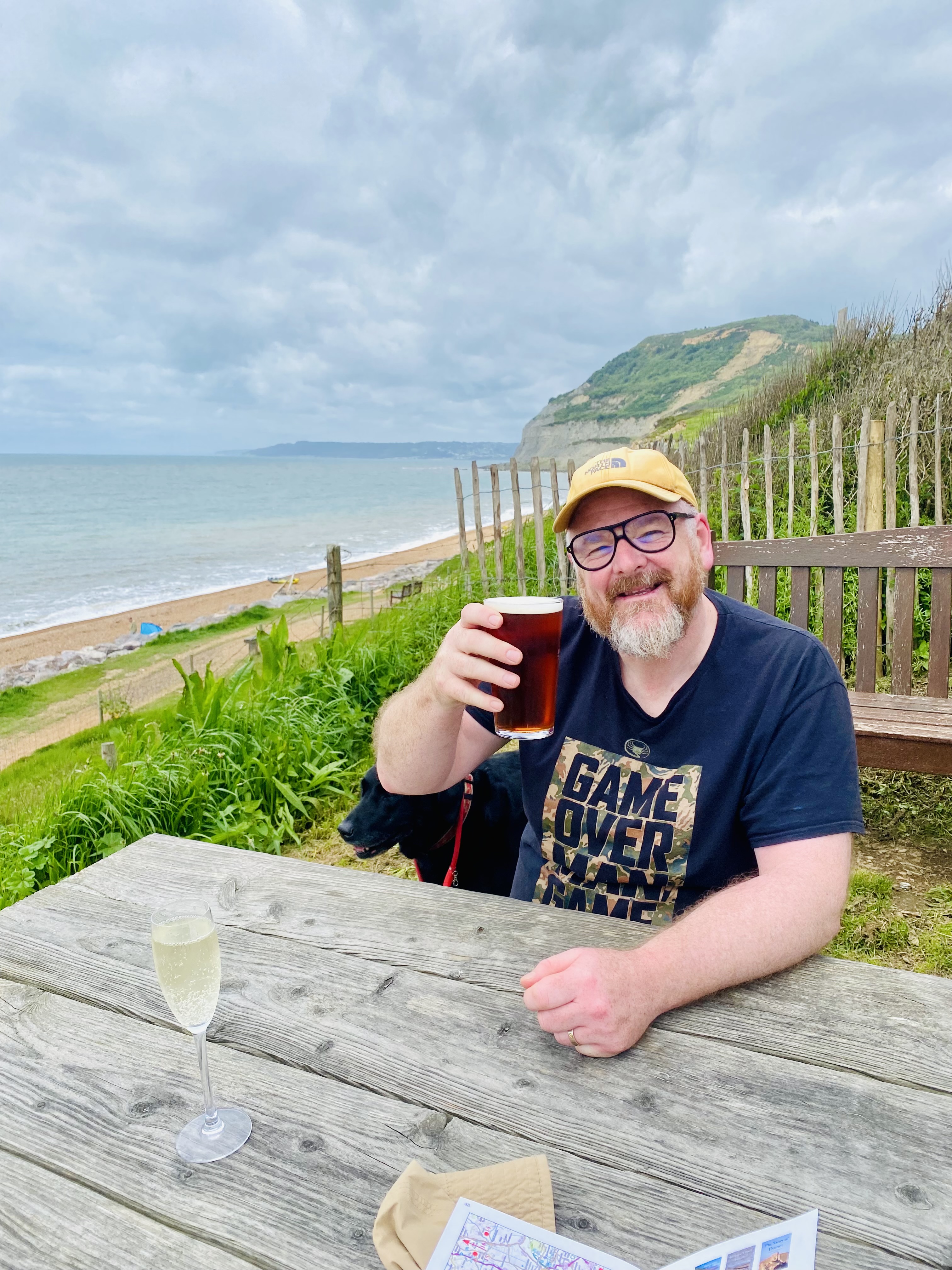
Si James is an online counsellor
What attracted you to become a therapist?
I was a social worker with children and families for nearly 25 years. I wanted to do something that did no harm. I often worked with families where I would have preferred to be in their corner, and I could see they needed support and time to process some pretty grim life experiences but were being combine harvested by the system.
Where did you train as a therapist?
Peterborough, Boston, and Gloucester.
Can you tell us about the type of therapy you practise?
Person-centred. It seems to just fit me, is less “extra”, and I hate directive stuff.
I think most adult clients aren’t that aware of the modality, but youth clients have loved it and have said things like they’ve never experienced therapy like it, or being spoken to in that way. In a good way, I mean. I’ve seen teenagers slowly blossom. Teens also keep you young minded, guarantee challenge so you don’t get cocky or set in your ways, and are literally hilarious.
I also use aspects of existentialism. I think it’s important to think about death, and what the whole point of it all is -- the long double maths of the soul.
How does person-centred therapy help with symptoms of low esteem?
Well, when I went to my first humanistic counsellor, I was blown away. A man who was genuinely interested in me, open, warm, encouraging, able to draw out the gold and home in on things I had never considered. I hope I do that. I feel that I do, because I've seen awkward and shy teenagers open up and get real. Some people just forget who they are from time to time.
What sort of people do you usually see?
I’m a secondary school counsellor, and I have a private practice with adults coming, so far. I would say the main theme is life’s reasonable horror, and the isolation and sadness that result. Specifically, low esteem, trauma, and fear.
Have you noticed any recent mental health trends or wider changes in attitude?
As a society we need to talk about COVID. No society in the modern age, bar when in 1208, Pope Innocent III placed England and Wales under an Interdict, has had a 24/7 lockdown that prevented daily normal socialisation -- including The Blitz, which was only a curfew (the pope closed churches, suspended public gatherings, and denied burials for more than seven years because King John refused the Popes choice of Archbishop of Canterbury).
You can’t do that to a society and then pretend everything is normal one morning. Some people literally thought it was the end of the world, and lost everything and loved ones. I think it’s a source of much mental health distress and unresolved existential stuff.
I also think people are deeply stressed, sad and disconnected because most people are doing the job of three people on the salary of less than one of them. We’re governed by deeply suspect parties and, as Blur said, “modern life is rubbish”- if you’re working class.
I also feel for women, especially young women at school/ college, who are going through terrible emotional and sexual treatment by men. It’s a pandemic.
What do you like about being a therapist?
Meeting wonderful people, having the honour of being part of their life in a way literally no other ever can, and doing no harm. Seeing them release, and realise things. Seeing tears and smiles and being there in the evolution.
To finally have a job I look forward to upon waking up, can read about and apply things to (because it hasn’t had the soul sucked out of it by bureaucracy) and has virtually no admin.
What is less pleasant?
Seeing the profession writing a suicide note by accepting the so called professionalisation and protection of the name counsellor. This happened to social work in the early 2000’s and has literally killed something that was once about helping people and made it a technocratic, heartless, inept and morally bankrupt state intervention. It draws in people outside the ethics and practice, who are more into selling the crap that interrupts your Netflix series every 5 minutes.
We don’t need a public advisory body -- they will literally take lots of your money, exist only to punish, do no training, advocacy or facilitation, and make no difference in outcome than what is already achieved through to the bodies that already exist -- some of whom have gone full paternalistic dictator on the subject, which breaches about every ethic and value going. Also, this stupid focus on having a degree -- as if that’s the only measure of intelligence or something. My step brother left school with literally no qualifications, and he’s ostensibly a millionaire now. The bastard.
And I don’t want a government knee deep in evil in the Middle East mandating what terrorism is and spying on me in fear based supervisions.
How long have you been with Welldoing and what you think of us?
I've only just joined. Its more proactive, personalised and interesting than some others. I really loved the free CPD the other day about Odysseus and practice! It felt like a community of friends. Really pleased so far!
What books have been important to you in terms of your professional and personal development? Do you ever recommend books to clients?
I loved Feeling Like Crap by Nick Luxmoore, the school counsellor.
I like anything by Irvin Yalom, because he makes me think and makes me laugh.
I’ve recommended books like The Five Love Languages by Gary Chapman because a simple model like that could save a marriage. As long as you see it as just a model, like Maslow’s. Bin it if it doesn’t connect.
I tend to be influenced by non-text books that somehow evoke a mood and vibe or metaphor that relates. Like if you are locked in melancholy introspection, books like So The Wind Won’t Blow It All Away by Richard Brautigan and Reflections In A Golden Eye by Carson McCullers kind of make you feel known.
What you do for your own mental health?
I joined a garage goth band at age 50. Literally. I’m having a wonderful time. We’re called Tiny Forehead if you’re interested!
I’ve rediscovered walking in nature. It's healing, for reasons I can’t explain.
I’ve worked out who my tribe are, and they transcend beliefs, class and education. I tend to hang with them as it's less like grinding metal.
I don’t do anything I don’t like anymore, unless it is job related, useful to self, or relates to someone I love. Why did I ever go to a nightclub, a party, or Harlow? Jog on.
You are a therapist in Nottingham. What can you share with us about seeing clients in this area?
To be honest I can’t see how it’s that different to anywhere else. But it’s a unique friendly city, compact, great music scene and gastro scene, in the middle of forests, and like really near everywhere. I think perhaps my clients more represent every ethnicity and age and social strata then elsewhere.
What’s your consultation room like?
It’s a private large room (converted garage) that has an ensuite, so people never have to leave it and wander round your house mumbling an embarrassed hello to family members and cats searching for the bathroom. It's calm, with a great sofa, but I’m never really sure whether to do it out how I really want/ reflecting me or leave it neutral.
What do you wish people knew about therapy?
That it’s vital having someone with “no skin in the game” coming alongside you and helping you see yourself, your life and your circumstances for what they are- and finding a way forward. That we don’t have to walk around like an empty tube full of demons, and can be heard by kind people. And that’s it’s not all about crisis. And there is zero judgement.
What did you learn about yourself in therapy?
That ultimately I’m the captain of my life and only I have the answers and solutions. There’s no such thing as fate. That I’m ok.