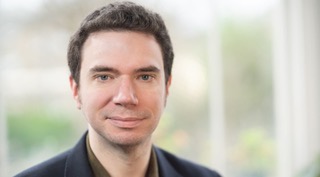
Matthew Eaves is an online therapist
What attracted you to become a therapist?
There were a couple of draws towards therapy for me.
First, and perhaps most importantly, I had a fantastic experience of therapy as a client. I went through a very dark period in my life so much so that I became agoraphobic to the point I could scarcely leave my bedroom. Working through my feelings and beliefs about myself, others, and the world alongside my therapist was a transformative experience for me. There came a point between two sessions, as I reflected on my own, in which I suddenly found myself able to look upon myself with compassion and re-interpret my understanding of who I was and am, and how I fit into the world. I remember, a few minutes later when I stood up, understanding for the first time what people meant by ‘feeling lighter’ and ‘putting down a burden’ – those ideas felt more than figurative: I felt physically different, almost as though I could push off from the ground and fly. My back literally clicked because I was standing up straight for the first time in years. Knowing from first hand experience that therapy can have that effect inspired me and led me to wonder if I might be able to offer that support to others.
Secondly, I had studied philosophy at degree level and wanted to put it to practical use. As intriguing as it is to think about abstract philosophical issues, putting thought to a practical use that makes a difference to people is another level of fulfilling altogether.
Where did you train as a therapist?
I studied for a Postgraduate Diploma in Counselling and Psychotherapy at York St John University. It’s one of the most well-regarded training institutes for humanistic schools of counselling and I feel privileged to have studied there. I feel very lucky to have had Professor Lynne Gabriel, OBE and President of the BACP, as my director of study and to have worked under her on my training placement.
Can you tell us about the type of therapy you practise?
I’m an existential therapist. What that means in practice is that I work from a philosophical and relational basis, rather than a medical or cognitive one. Rather than applying labels to my clients, I treat their experiences as unique human journeys with their own individual ways of making sense of the world, and their own tensions and difficulties.
I see it as my role to help clients explore, be heard, and then collaboratively to make sense of their difficulties and work together to discover different ways of understanding things and approaching them. We can then experiment with different ways of viewing and interacting with their worlds. The aim is for clients to ultimately create more fulfilling paths for themselves that benefit both them and those around them.
How does existential therapy help with symptoms of anxiety?
Rather than coming up with a sticking plaster solution, I try to go beyond ‘symptoms’. It takes time and effort, but my way of working is all about addressing the underlying cause of my clients’ difficulties. That’s not to say we don’t talk about how they feel and how it’s effecting them, on the contrary, it’s central. But the value in exploring and understanding those felt effects is, in part, about working out what they are telling you, as the client: what are those feelings indicating? What’s beneath the surface?
By working together to get to the heart of the matter we can do more than coming up with ways of ‘putting up with’ difficulties or silencing our thoughts and feelings – we can change them for good.
What sort of people do you usually see?
I don’t know if I can pin-down a specific demographic. I choose only to work with adults, but beyond that, my clients are all unique to me! I work with people with a mix of genders and identities, religious and non-religious systems of belief, varying sexualities, ethnic and national origins, ages, and with wildly varying socio-economic origins and statuses.
I suppose what unites my clients is a willingness to build a relationship with me, to be open, and to commit to the work on the basis that I offer a space for deep reflection and change rather than quick fixes.
Have you noticed any recent mental health trends or wider changes in attitude?
Absolutely. I think over the last couple of decades people in general have been much more willing to talk about mental health issues and to seek support – whether that’s because the stigma is dropping away, or because the state of our society is making the need for help more acute and widespread I couldn’t say.
What do you like about being a therapist?
Everything, bar the admin. But what I like best of all is building real relationships, connecting with people, and that moment – it might come after five sessions, or fifty, or one-hundred-and-fifty – when something changes for the client, when their perspective shifts and new possibilities open to them. I know what that feels like and I feel so very glad to be able to help people find it for themselves, too.
What is less pleasant?
As I say, the admin.
How long have you been with Welldoing and what you think of us?
I’ve not been with Welldoing long at the time of writing – a month? Six weeks? Something like that, anyway. I’ve not had much chance to explore yet but I’m really looking forward to the chance to make use of the weekly CPD sessions!
What books have been important to you in terms of your professional and personal development? Do you ever recommend books to clients?
It’s pretty rare that I recommend books to clients, and even rarer that I’d recommend the same one to two clients – we’re all so different and need or respond to different things.
In terms of my own professional development Practising Existential Therapy by Ernesto Spinelli is my go-to and the foundation upon which I’ve built my approach to therapy. From a personal point of view, I’m a huge reader and I’ve been influenced by everyone from Jean-Paul Sartre to Ursula K Le Guin, from Jane Austin to Terry Pratchett, to R.D. Laing.
What you do for your own mental health?
Above all, seeking and maintaining relationships is important to me. Whether it’s family, friends, colleagues, clinical supervisors, or clients – each interaction acts to change and nourish me. Human beings don’t just thrive on relationships, we need them.
I also engage in journaling and creative writing as ways of exploring my emotional landscape, as well as engaging in personal therapy myself.
Getting out and about are important, too. Exploring a city centre of a woodland with someone I care about is great. Having that change of context, feeling connected to the world is renewing.
You are an online therapist. What can you share with us about seeing clients in this way?
Working remotely brings both its own challenges and possibilities. Not being in the same physical space as my clients can make things feel less ‘real’ particularly for the clients and I have to work harder to maintain engagement and to pick up on things that are happening for the client outside of the dialogue. This is especially true of telephone therapy. I’ve undertaking exhaustive additional training for remote work, though, and I try to address any issues arising from this way of working during the free consultation I offer clients in advance of our first session.
The benefits outweigh the challenges, though. Working remotely gives me the chance to work with clients from all over the country, and those who have accessibility needs that would make therapy impossible for them otherwise.
What’s your consultation room like?
It’s a room dedicated to therapeutic encounters. As a physical space it’s unremarkable: a room maybe 2m by 3m with a window, a door, a carpet, that could be anywhere on Earth. What makes it special is what happens there: I get the privilege there of doing what I’m passionate about, connecting with people and helping them explore their worlds and work through their difficulties. That’s why I’m excited to step into it every time.
What do you wish people knew about therapy?
Therapy isn’t about ‘fixing’ something that’s ‘wrong’ with you, and it’s not about a therapist ‘doing’ something to you, either. It’s about two human beings being open and honest with each other in a place of safety, a safe relationship, and working together to understand and work through difficulties together.
What did you learn about yourself in therapy?
As a client? I learned that I am who I choose to be. That, within the limitations of my body and mind, I can change and become a person who embodies the values I find meaningful.
As a therapist? That I am more open than I might have thought to the ways of being (thoughts, feelings, beliefs, wants, needs, and fears) of others and that in embracing people for who they are, I can be very helpful in supporting them to find their own paths forward, provided they’re open to it and to me.